
 Image 1 of 1
Protecting your central vision begins with early detection. Every comprehensive eye exam at The Eye Collective includes screening for age-related macular degeneration (AMD), with advanced imaging and personalized management designed to identify changes as early as possible.
Age-related macular degeneration is a progressive disease that affects the macula—the central portion of the retina responsible for sharp vision used for reading, driving, recognizing faces, and seeing fine detail. While AMD often develops gradually, many patients experience no noticeable symptoms in its earliest stages. As the disease progresses, central vision can become blurred, distorted, or develop permanent blind spots.
Age is the greatest risk factor for AMD, but genetics, smoking, cardiovascular disease, high blood pressure, excessive UV exposure, and family history can all increase your risk. Because the earliest stages often have no symptoms, routine eye examinations play a critical role in detecting changes before vision is affected.
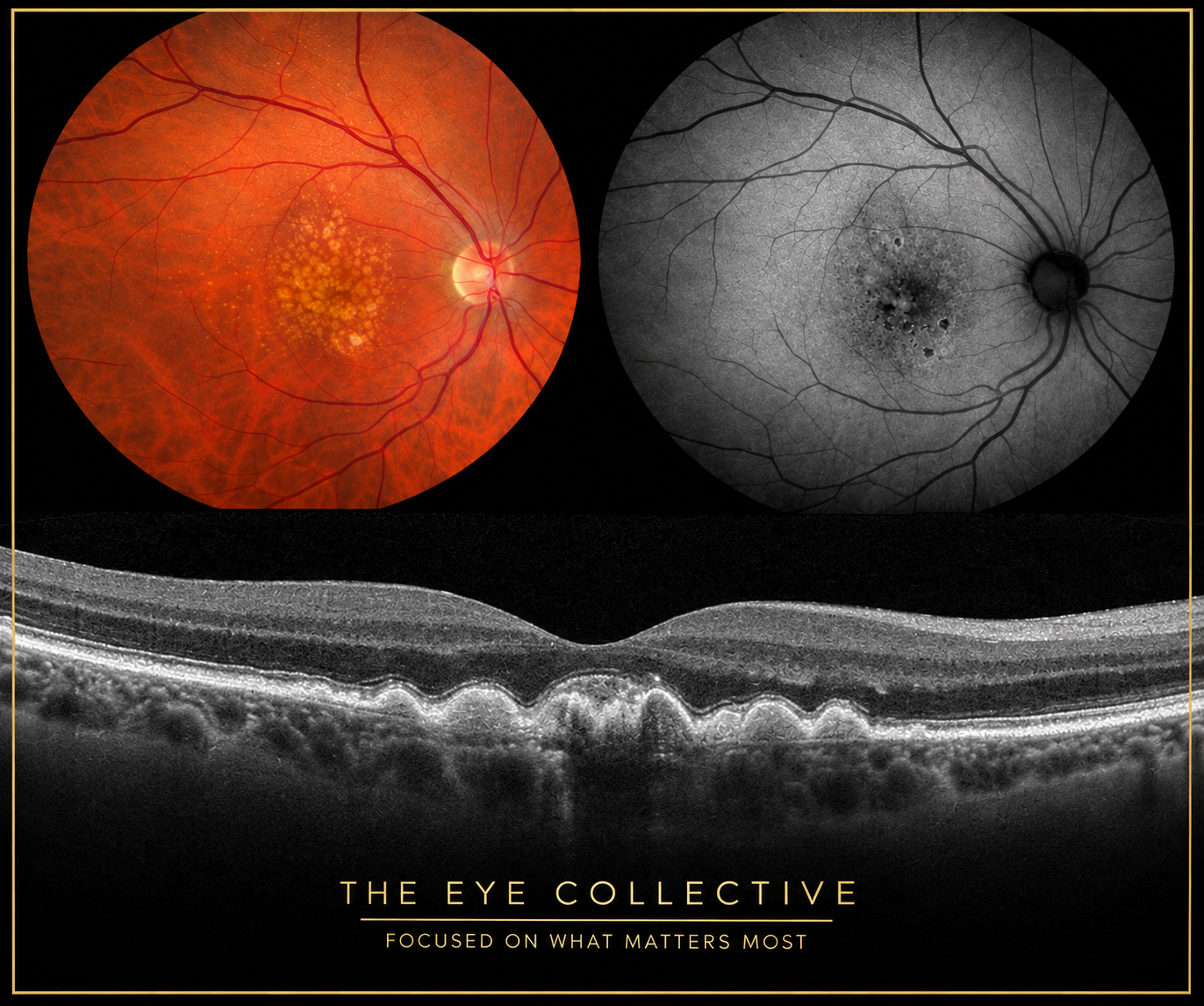
Every comprehensive eye exam includes a careful evaluation of your macula. For patients at increased risk or showing early signs of disease, we utilize advanced diagnostic technology to monitor even the smallest changes over time, including:
High-resolution retinal imaging (OCT)
Digital retinal photography
Dilated retinal examinations
Amsler grid education for home monitoring
Personalized risk assessment and nutritional counseling
One of the earliest signs of AMD is the development of drusen—small deposits that form beneath the retina. Researchers have discovered that these deposits contain proteins, including amyloid-beta, that are also found in the brain plaques associated with Alzheimer's disease. While having AMD does not mean a person will develop Alzheimer's disease, and the relationship is still being actively studied, these shared biological features highlight the importance of comprehensive eye examinations and may contribute to future advances in understanding both conditions.
If macular degeneration is detected, our goal is to slow progression and preserve your vision for as long as possible. Treatment recommendations may include lifestyle modifications, nutritional supplementation based on the AREDS2 guidelines when appropriate, home vision monitoring, referral for retinal treatment if wet AMD develops, and ongoing surveillance using advanced imaging technology.
Our goal is simple: to detect macular degeneration early, preserve your central vision, and partner with you through every stage of care so you can continue enjoying the activities that matter most.
Protecting your central vision begins with early detection. Every comprehensive eye exam at The Eye Collective includes screening for age-related macular degeneration (AMD), with advanced imaging and personalized management designed to identify changes as early as possible.
Age-related macular degeneration is a progressive disease that affects the macula—the central portion of the retina responsible for sharp vision used for reading, driving, recognizing faces, and seeing fine detail. While AMD often develops gradually, many patients experience no noticeable symptoms in its earliest stages. As the disease progresses, central vision can become blurred, distorted, or develop permanent blind spots.
Age is the greatest risk factor for AMD, but genetics, smoking, cardiovascular disease, high blood pressure, excessive UV exposure, and family history can all increase your risk. Because the earliest stages often have no symptoms, routine eye examinations play a critical role in detecting changes before vision is affected.
Every comprehensive eye exam includes a careful evaluation of your macula. For patients at increased risk or showing early signs of disease, we utilize advanced diagnostic technology to monitor even the smallest changes over time, including:
High-resolution retinal imaging (OCT)
Digital retinal photography
Dilated retinal examinations
Amsler grid education for home monitoring
Personalized risk assessment and nutritional counseling
One of the earliest signs of AMD is the development of drusen—small deposits that form beneath the retina. Researchers have discovered that these deposits contain proteins, including amyloid-beta, that are also found in the brain plaques associated with Alzheimer's disease. While having AMD does not mean a person will develop Alzheimer's disease, and the relationship is still being actively studied, these shared biological features highlight the importance of comprehensive eye examinations and may contribute to future advances in understanding both conditions.
If macular degeneration is detected, our goal is to slow progression and preserve your vision for as long as possible. Treatment recommendations may include lifestyle modifications, nutritional supplementation based on the AREDS2 guidelines when appropriate, home vision monitoring, referral for retinal treatment if wet AMD develops, and ongoing surveillance using advanced imaging technology.
Our goal is simple: to detect macular degeneration early, preserve your central vision, and partner with you through every stage of care so you can continue enjoying the activities that matter most.